Turn Booth Traffic Into Sales Conversations With Branded Trade Show Games
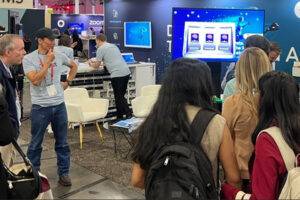 Trade show success is not measured by how many people walk past your exhibit. It is measured by how many people stop, engage with your team and become worthwhile leads.
That is difficult on a crowded show floor. Attendees are surrounded by competing displays, sales messages, demonstrations and giveaways. Even an attractive exhibit can be overlooked when visitors do not have an immediate reason to stop.
A branded trade show game provides that reason.
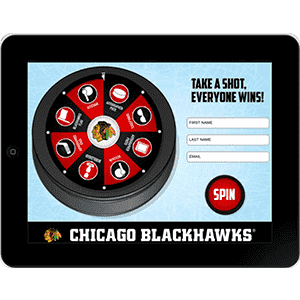
Digital prize wheels, trivia challenges, Memory Match games, slot machines, Plinko-style games and other interactive experiences can attract attention from across the show floor. More importantly, they give booth staff a natural way to begin conversations, collect qualified lead information and create a memorable experience connected directly to the exhibitor’s brand.
The best trade show games do much more than entertain. They become practical marketing tools that support the entire event strategy.
Why Trade Show Booths Need More Than an Attractive Display
A professional booth design is important, but appearance alone does not always create participation. Attendees may admire a display without stopping long enough to learn about the company behind it.
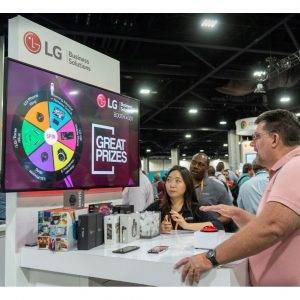 An interactive game changes the attendee from an observer into a participant.
When people see someone pressing a large button, spinning a digital slot machine or competing for a leaderboard position, they become curious. That visible activity helps the booth feel approachable and gives attendees a clear understanding of what they can do when they stop.
This produces several valuable results:
- More people notice the booth.
- Attendees have a reason to stop.
- Booth staff can begin conversations more naturally.
- Visitors remain at the booth longer.
- Lead information can be collected during the experience.
- Products, services and marketing messages can be incorporated into the game.
- Prizes and promotional inventory can be controlled automatically.
- Follow-up can begin immediately after the interaction.
The game attracts the visitor, but the conversation creates the business opportunity.
Turn a Cold Approach Into a Natural Conversation
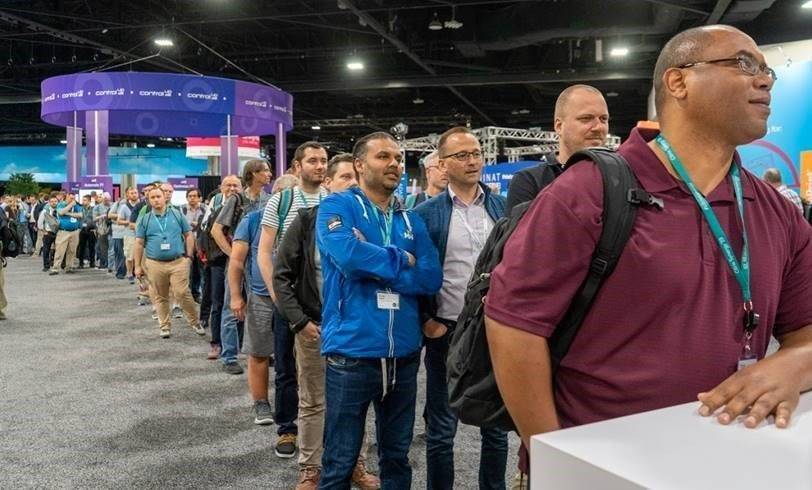 Starting conversations with strangers is one of the more difficult parts of working a trade show. Booth staff may hesitate to approach passing attendees, while visitors often try to avoid an obvious sales presentation.
A game provides a comfortable introduction for both sides.
Instead of opening with a sales pitch, a staff member can simply invite the attendee to play. While the visitor waits for a turn or completes the game, the representative has an opportunity to ask what brought the attendee to the show, what type of solution they need or what challenges their company is facing.
The interaction feels less forced because the game has already created a shared activity.
A simple invitation such as “Would you like to try our prize wheel?” can develop naturally into questions such as:
- What type of company are you with?
- What brought you to the show?
- Are you currently using a product like ours?
- What is the biggest challenge you are trying to solve?
- Would you like someone from our team to follow up after the event?
This is one of the greatest advantages of a branded booth game: it creates a dependable opening for a real business conversation.
Capture Qualified Leads, Not Just Names and Email Addresses
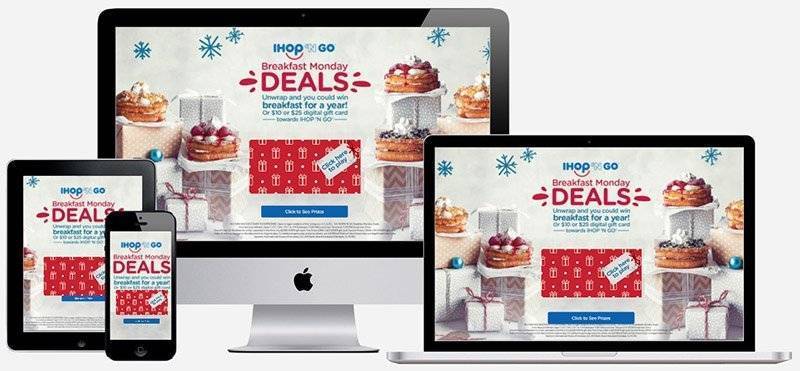 Collecting contact information is useful, but a long list of names does not necessarily give the sales team what it needs.
A well-designed lead generation game can collect both contact information and qualification details. Before playing, attendees can complete a brief form using fields selected specifically for the campaign.
Possible fields include:
- Name
- Email address
- Company
- Job title
- Phone number
- Product interest
- Buying timeframe
- Company size
- Preferred contact method
- Custom survey questions
- Marketing consent
The form should remain short enough that it does not discourage participation. In many cases, three or four carefully chosen questions will produce better results than a long registration form.
The goal is not to collect every possible detail. It is to gather enough information for the sales team to recognize promising opportunities and conduct a more relevant follow-up.
Collected information can be exported after the event or sent to a CRM, email platform or other sales system through an integration such as Zapier.
Choose Between Fast Traffic and Longer Engagement
Not every exhibitor has the same goal.
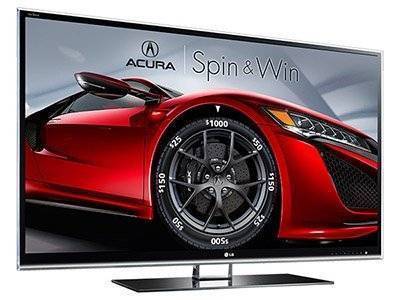 Some booths need to serve hundreds or thousands of attendees quickly. Others want fewer but longer and more educational interactions. Choosing the right game format helps control the type of traffic the booth receives.
Fast instant-win games
A Virtual Prize Wheel, digital Scratch Off, Slot Machine or Plinko-style game can be completed quickly. These are good choices when the primary objectives are:
- Attracting a large crowd
- Distributing prizes
- Collecting a high volume of leads
- Keeping lines moving
- Creating visible excitement
- Giving every visitor a simple experience
The rules are immediately understood, so very little explanation is required.
Skill and knowledge games
Trivia, Memory Match, Tic-Tac-Toe, Photo Hunt and other score-based challenges can hold attention longer. These games work well when the objectives include:
- Product education
- Brand-message retention
- Friendly competition
- Leaderboard participation
- Longer conversations
- Repeat visits to the booth
- Demonstrating products or benefits
The correct game depends on booth size, expected attendance, available staff and the value of each potential lead.
Manage Busy Booth Traffic
A successful attraction can create a new challenge: too many people waiting to play.
Game duration should therefore be considered before the event. A quick instant-win game can process more visitors than a multi-question trivia challenge. If longer gameplay is valuable, the booth may need multiple devices or a separate area for the game.
Possible configurations include:
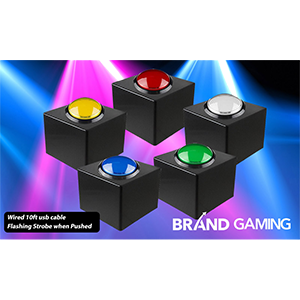
- One large display with a physical push button
- A touchscreen monitor mounted in the booth
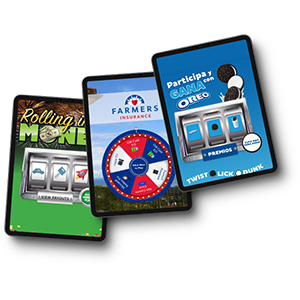
- Multiple tablets operating at the same time
- A self-running kiosk
- QR-code access on attendees’ phones
- A large screen for gameplay with a separate tablet for registration
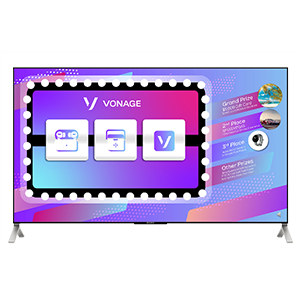
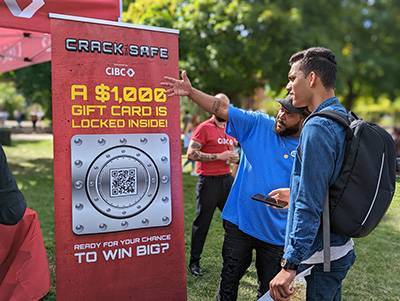 QR-code play can be particularly helpful during busy periods because attendees use their own phones instead of waiting for a shared screen. However, a large animated display usually provides more visual impact when attracting people from across the show floor.
The ideal setup often combines both approaches: a prominent big-screen game for attention and mobile access for additional participation.
Use the Game to Educate Attendees
Trivia is an obvious educational choice, but it is not the only game that can communicate useful information.
A Memory Match game can pair:
- A product with its primary benefit
- A service with the problem it solves
- A product image with its name
- An industry challenge with the company’s solution
- A feature with its practical application
A Photo Hunt game can encourage attendees to closely examine product images or advertisements. A tap-style game can ask players to select desirable items while avoiding common problems. Branded Tic-Tac-Toe icons can represent products, divisions or services.
Educational messages can also appear after a correct answer, completed match or successful game action.
The key is to keep the experience enjoyable. The game should introduce and reinforce important messages without feeling like a disguised sales presentation.
Control Prizes Without Losing Control of the Budget
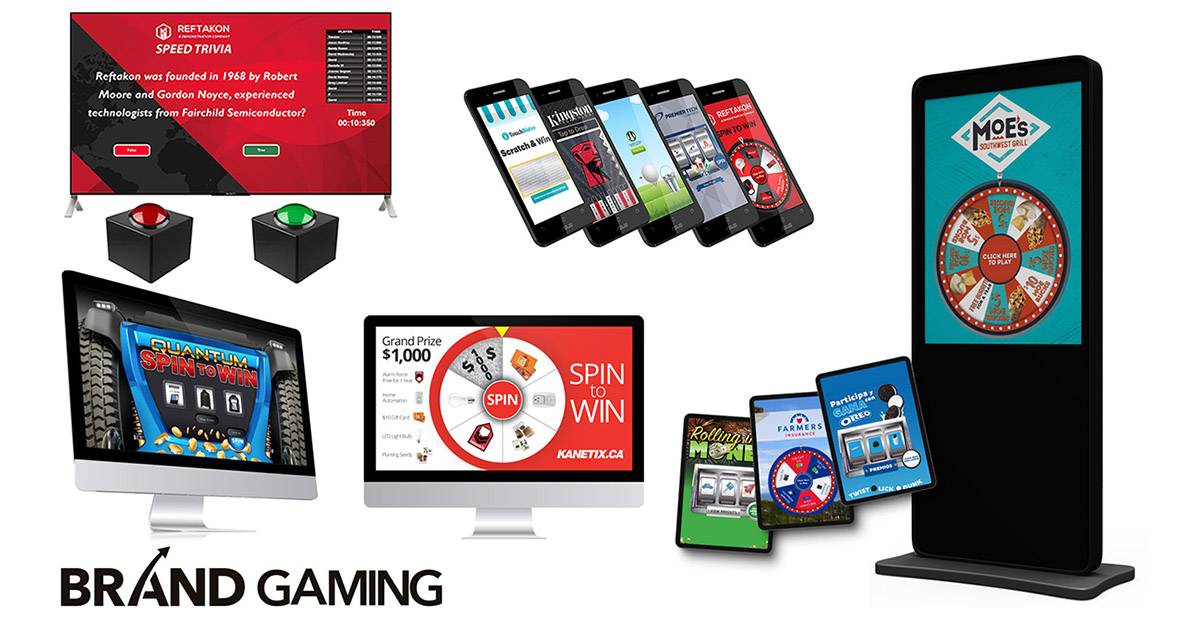 Giveaways are a proven way to increase participation, but prize distribution must be managed carefully.
An inventory-controlled instant-win game allows the exhibitor to determine:
- The available prize levels
- The quantity available at each level
- The likelihood of winning
- Whether every participant wins
- How many prizes may be awarded during the campaign
- When particular prizes are available
- What happens after a prize inventory is exhausted
The system tracks prize availability automatically, helping prevent a prize from being awarded after the available supply has been depleted.
Different inventories can also be established for separate days, locations or events. This helps prevent the entire prize supply from being distributed during the first morning of a multi-day show.
Prizes do not need to be expensive. Useful possibilities include:
- Branded merchandise
- Product samples
- Digital gift cards
- Discount codes
- Free consultations
- Upgraded services
- Sweepstakes entries
- Access to premium content
- Donations made on the player’s behalf
A well-chosen prize should be relevant to the intended audience and appropriate to the value of the interaction.
Continue the Experience After the Game
The marketing opportunity should not end when the animation stops.
After playing, an attendee can receive a branded email containing:
- Prize confirmation
-
Redemption instructions
- A coupon or promotional code
- A barcode
- A link to a product page
- A downloadable resource
- Contact information for the appropriate sales representative
- An invitation
- A follow-up survey
-
To schedule a demonstration
Different results can also direct players to different web pages. For example, a winner may be sent to prize-claim instructions, while another participant may receive a product offer or invitation to enter a larger drawing
A useful follow-up gives the attendee a reason to interact with the brand again after leaving the booth.
Measure More Than the Size of the Crowd
A busy booth looks impressive, but activity should be measured whenever possible.
Depending on the game and campaign configuration, useful measurements may include:
- Number of players
- Number of leads collected
- Form completion rate
- Product-interest responses
- Prizes awarded
- Remaining prize inventory
- Activity by day
- Coupon or code distribution
- Follow-up email activity
- Leads sent to the sales team
These results can help demonstrate the value of the event and improve the strategy for the next show.
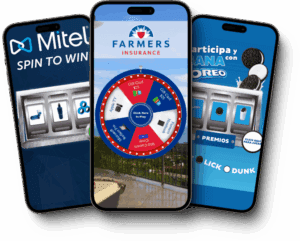 For example, an exhibitor may discover that one prize attracts significantly more players, that shorter forms increase participation or that trivia questions reveal gaps in customer understanding. That information can influence future booth designs, sales presentations and marketing campaigns.
Reuse a Successful Game at Future Events
Companies that attend multiple trade shows should not have to rebuild their entire promotion every time.
A branded game can often be reused while updating:
- Event dates
- Prize inventories
- Background graphics
- Marketing messages
- Lead questions
- Rules
- Sponsor logos
- Calls to action
- Follow-up emails
Reusing a proven game saves preparation time and keeps the brand experience consistent across regional events, annual conferences and sales meetings.
The same basic game can also be adapted for different situations. A large-screen version may be used at a national trade show, while a tablet or QR-code version can be used at smaller regional events.
Prepare the Game Before Show Day
Technology should be tested before attendees arrive.
Important preparations include:
- Confirming the screen resolution and orientation
- Testing the game in full-screen mode
- Checking the event’s internet connection
- Confirming that tablets and computers have reliable power
- Testing touch controls or the physical push button
- Reviewing lead form fields
- Testing prize inventories and winning results
- Confirming follow-up emails
- Training booth staff on the game flow
- Preparing an internet backup when possible
Brand Gaming provides browser-based games that work on modern computers, tablets, kiosks, large displays and mobile phones. No special application download is normally required. Limited offline options may also be available when reliable event internet cannot be guaranteed.
Early testing gives the booth staff confidence and prevents avoidable technical questions during the event.
Make the Game Look Like Part of the Campaign
A generic game may attract attention, but a fully branded game builds recognition.
Branding can extend beyond adding a logo. Depending on the game, customization can include:
- Background design
- Brand colors
- Fonts
- Buttons
- Game pieces
- Prize names
- Product images
- Sound effects
- Educational messages
- Winner screens
- Follow-up emails
- Coupons and prize codes
The finished game should look as though it belongs within the exhibit—not like an unrelated arcade game that was added at the last moment.
See examples of previously created experiences in the Brand Gaming Game Showcase.
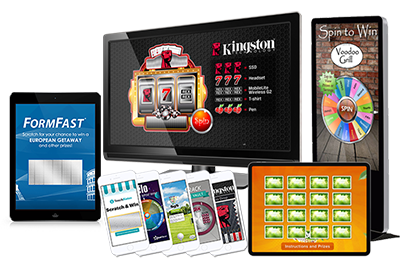 Select a Game Based on Your Business Objective
Before choosing a game, decide what the event needs to accomplish.
Ask the following questions:
- Is the main goal attracting attention or educating attendees?
- How many people are expected to play?
- How long should each interaction last?
- Will contact information be required?
- What information does the sales team need?
- Will prizes be awarded?
- How many devices will be available?
- Is reliable internet available?
- Should the experience encourage repeat play?
- What should happen after the game?
The best trade show game is not necessarily the most complicated one. It is the game that supports the booth’s sales and marketing objectives while remaining easy and enjoyable for attendees.
Create an Experience That Leads Somewhere
Crowds, lights and sound may get attention, but successful trade show marketing requires a clear next step.
A branded game should help the exhibitor:
- Stop the right attendees
- Begin useful conversations
- Identify qualified prospects
- Communicate a memorable message
- Control prize distribution
- Collect actionable information
- Continue the relationship after the event
When those elements work together, the game becomes much more than entertainment. It becomes part of the sales process.
Brand Gaming creates fully branded trade show games for big screens, touchscreens, tablets, kiosks, websites and mobile devices. Promotions can include lead capture, prize inventory control, player restrictions, branded email, QR codes, coupon delivery, CRM automation, push-button activation and custom development.
Call Brand Gaming at 1-877-530-4499 to discuss your event, booth setup and promotional goals.
Frequently Asked Questions About Branded Trade Show Games
What is a branded trade show game?
A branded trade show game is an interactive digital activity customized with a company’s logo, colors, products, messaging and prizes. It can be used to attract booth visitors, collect leads, educate attendees or distribute controlled instant-win prizes.
Which games work best for attracting trade show traffic?
Prize wheels, Plinko-style games, slot machines and digital scratch-off games are strong traffic builders because attendees understand them immediately and each play can be completed quickly. Large-screen animation and sound can make the activity visible from across the show floor.
Can a trade show game collect leads?
Yes. An optional registration form can collect names, email addresses, company information, phone numbers and custom qualification questions. Data can be exported or transferred to other marketing and sales applications.
Can we control how many prizes are awarded?
Yes. Inventory-controlled games allow the exhibitor to establish the available quantity for each prize level. Once a prize supply is exhausted, the system prevents additional awards from that inventory.
Does every player need to win a prize?
No. The promotion can include winning and non-winning results, or it can be configured so every participant receives something. The right approach depends on the number of expected players and the available prize budget.
What equipment is needed?
Games can run on modern computers, tablets, touchscreen displays, kiosks and mobile phones. Large-screen games may also be activated with an optional physical push button. The best equipment depends on booth size and expected attendance.
Is internet service required?
Online operation provides full access to lead collection and real-time prize inventory control. Limited offline configurations may be available for venues where internet service is unreliable. Internet requirements should be discussed and tested before the event.
Can several people play at the same time?
Multiple tablets, kiosks or mobile devices may be used when the campaign is configured for simultaneous participation. QR-code access also lets attendees play on their own phones and can reduce waiting during busy periods.
Can the game match our exact branding?
Yes. Backgrounds, logos, colors, fonts, game pieces, buttons, prizes and messaging can be customized. The objective is to make the game look like an intentional part of the overall campaign.
How can a game educate attendees?
Trivia questions can teach players about products and services. Memory Match can pair products with benefits, while other skill games can reveal educational messages during play. The educational content should remain brief, visual and easy to understand.
How quickly can a branded game be ready?
Many established game formats can be branded and deployed within a few days. Custom development and unusual screen configurations may require additional time. Rush projects may be possible depending on the requested features.
Can we use the same game at several trade shows?
Yes. A game can often be reused while updating dates, prize inventories, graphics, messages and lead questions for each event. This is useful for road shows, regional sales teams and companies that exhibit throughout the year.
What happens to the leads after the show?
Lead data can be exported for the sales team or sent automatically to a CRM, email platform or other application through integrations such as Zapier. Players can also receive an immediate branded follow-up email after participating. Be compliant about your email sending.
How do we measure the success of a trade show game?
Common measurements include total players, leads captured, qualification responses, prizes distributed, activity by day and follow-up results. These figures can be compared with the event cost and previous trade show performance.
How much does a branded trade show game cost?
Pricing depends on the game, event length, anticipated play volume, lead collection requirements, email usage and customization. Typical Brand Gaming trade show projects generally range from $330 to $430 per event, with custom projects quoted individually.
Call now! 1-877-530-4499 for a fast quote and more detailed information.
Why Brand Gaming? We make this easy to do!
We will work directly with you to execute your promotion or application to be certain you are leveraging the full value of our systems. Secondly, we know that one size does not fit all and you don’t have the time to master every aspect of our technology. Most importantly Brand Gaming will work with you to build out your promotion. The execution does require good communication.